Business Clarity Article
What Makes A Website A Business Asset?
Your website should become the clearest representation of your business.
Most businesses already have value.
They already provide services. They already serve customers. They already solve problems.
The challenge is not always creating more value.
The challenge is helping that value become easier to understand.
Potential customers form impressions from many different sources. Google forms impressions from many different sources. Artificial intelligence systems form impressions from many different sources. Future systems will do the same.
A website has a unique role within that environment. It is often the one place where a business can intentionally organize, clarify, and communicate its reality.
That is when a website begins transforming from a collection of pages into a true business asset.
Information Is Not Enough
Most Websites Store Information
Most websites contain information.
They list services. They provide contact details. They display photos. They describe the business.
They may even include reviews, service areas, and frequently asked questions.
Yet information alone does not automatically create understanding.
A True Business Asset Does More
A true business asset helps visitors connect the information they encounter to the reality of the business behind it.
The goal is not simply to store information.
The goal is to help the business become easier to understand.
Raw Material vs Outcome
Information Does Not Automatically Create Understanding
Many business owners assume that once information is published, understanding naturally follows.
Unfortunately, that is not always the case.
A website may contain service descriptions. A Google Business Profile may contain categories and reviews. Directories may contain business details. Photos may show completed work. Search results may provide additional information.
Each source contributes something.
Yet none of them automatically guarantee understanding.
Understanding Requires Connection
Understanding requires more than information.
Understanding requires information that works together.
When information exists in isolation, people and machines are left to assemble their own conclusions.
Information is the raw material. Understanding is the outcome.
Digital Points Of Light
A Business Is Often Understood Through Many Digital Points Of Light
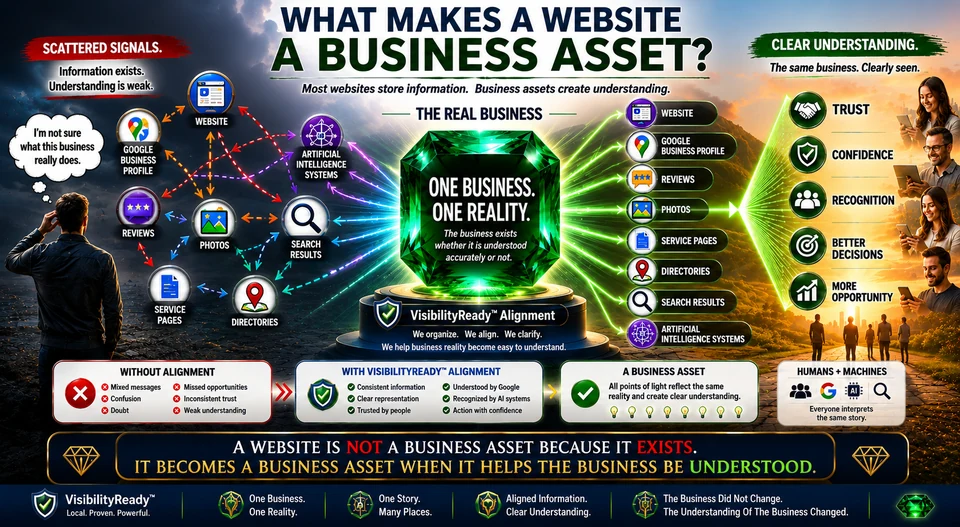
A website is one point of light. A Google Business Profile is one point of light. Reviews are points of light. Photos are points of light. Service pages are points of light. Directory listings are points of light. Search results are points of light. Artificial intelligence summaries are points of light.
Scattered Signals
When those points of light communicate different realities, confusion can emerge.
The business may be excellent. The services may be excellent. The customer experience may be excellent.
Yet understanding may remain weak because the signals do not reinforce one another.
Focused Understanding
When those points of light reflect the same reality, something different begins to happen.
Understanding becomes easier. Recognition becomes easier. Trust becomes easier.
When those points of light reflect the same reality, they focus into a clear and recognizable business, like a laser.
Why It Matters
The Cost Of Being Misunderstood
Understanding affects opportunity.
Every day, potential customers, referral partners, Google, artificial intelligence systems, and future technologies form impressions based on the information available to them.
Those impressions influence decisions.
Some decisions happen immediately. Some develop over time. Some opportunities are never fully recognized because the business was not clearly understood in the first place.
The Cost Is Not Always Obvious
It may not appear as a single missed lead or a single missed sale.
Instead, it often appears as lost momentum, lost trust, lost confidence, lost referrals, lost recommendations, and lost opportunities that never progress far enough to become visible.
A misunderstanding today can affect opportunities tomorrow. A misunderstanding repeated over months or years can affect how the market perceives the business altogether.
The Source Of Truth
One Business. One Reality.
Behind every website, profile, review, photo, service page, directory listing, and artificial intelligence summary is a real business.
That business exists whether it is represented accurately or not.
It exists whether customers understand it clearly or not.
It exists whether Google interprets it correctly or not.
It exists whether artificial intelligence systems describe it accurately or not.
The reality of the business does not change simply because the information surrounding it changes.
The Strongest Websites Do Not Invent Reality
They clarify it.
They organize it.
They communicate it.
They help other digital points of light reflect it more consistently.
ONE REALITY.
A Living Business Asset
A Valuable Website Can Change As The Business Changes
A mature business is not static. Services evolve. Stronger specialties emerge. Better proof develops. Customer fit changes. The business may become more selective about the work it wants.
To connect that direction to your service priorities, explore whether your website attracts the work you actually want.
A true website asset should be able to reflect those changes without forcing the business to keep presenting an older version of itself.
The website becomes more valuable when it remains aligned with the business that exists now.
The Website Holds The Clearest Current Statement
When important business information changes, the website can clarify the current reality first.
Other public signals can then be brought back into alignment around that same reality.
The goal is not constant rewriting. The goal is preventing yesterday's business description from becoming tomorrow's source of confusion.
Bringing The Pieces Together
Most Businesses Do Not Need A New Story
They need a clearer picture.
The information already exists. The challenge is that it is often scattered across multiple places.
A website. A Google Business Profile. Reviews. Photos. Service pages. Directory listings. Search results. Artificial intelligence summaries.
Each piece may be accurate on its own. Yet the complete picture may still be difficult to see.
VisibilityReady™ Helps Bring Those Pieces Together
Not to create a different business.
Not to create a better story.
But to help reveal a clearer picture of the business that already exists.
That is why your website should become the clearest representation of your business.
Alignment Creates Understanding
Alignment Does Not Change The Business
Alignment helps the business communicate more clearly.
It helps organize information around the reality of the business.
It helps remove contradictions. It helps reduce confusion. It helps strengthen the connection between what the business is and how the business is understood.
Your Website Should Not Compete With Other Signals
Your website should not compete with your Google Business Profile.
Your website should not compete with your reviews.
Your website should not compete with your other digital points of light.
It should help bring them together around the same business reality.
Why A Website Matters
Because Your Potential Customers Expect It
Customers may discover a business through Google. They may see reviews first. They may receive a referral. They may encounter the business through social media, a directory listing, or an artificial intelligence recommendation.
Yet many of them will still look for a website.
They expect to find one. They expect it to help answer questions. They expect it to confirm they have found the right business. They expect it to look professional. They expect it to help them decide what to do next.
Professional Expectations Matter
The situation is similar to a business using a free email address instead of a domain-based email address.
There is nothing inherently wrong with it.
But many people instinctively perceive the business differently.
A website often serves the same purpose. It helps establish legitimacy, organize information, reinforce trust, and intentionally communicate business reality.
The Audience Has Changed
Humans And Machines Interpret The Same Story
A website is not only read by potential customers.
Customers
Customers use business information to decide whether the business feels relevant, trustworthy, and worth contacting.
Google uses business information to better understand what the business does, where it operates, and who it serves.
Artificial Intelligence And Machines
Artificial intelligence systems and other machine systems may classify, connect, summarize, describe, or recommend the business.
The clearer and more consistent the information becomes, the easier it is for all of them to understand the business.
That is why clarity is no longer only a design issue. It is a business representation issue.
Clear Understanding Creates Opportunity
When A Business Becomes Easier To Understand, Everything Downstream Becomes Easier
Trust becomes easier to build.
Confidence becomes easier to establish.
Recognition becomes easier to earn.
Recommendations become easier to support.
Customer decisions become easier to make.
The business does not become valuable because the website says it is valuable. The business becomes easier to value because the website helps communicate that value clearly.
A WEBSITE IS NOT A BUSINESS ASSET BECAUSE IT EXISTS.
IT BECOMES A BUSINESS ASSET WHEN IT HELPS THE BUSINESS BE UNDERSTOOD.
YOUR WEBSITE SHOULD BECOME THE CLEAREST REPRESENTATION OF YOUR BUSINESS.