Business Clarity Article
Why Strong Businesses Look Weak Online
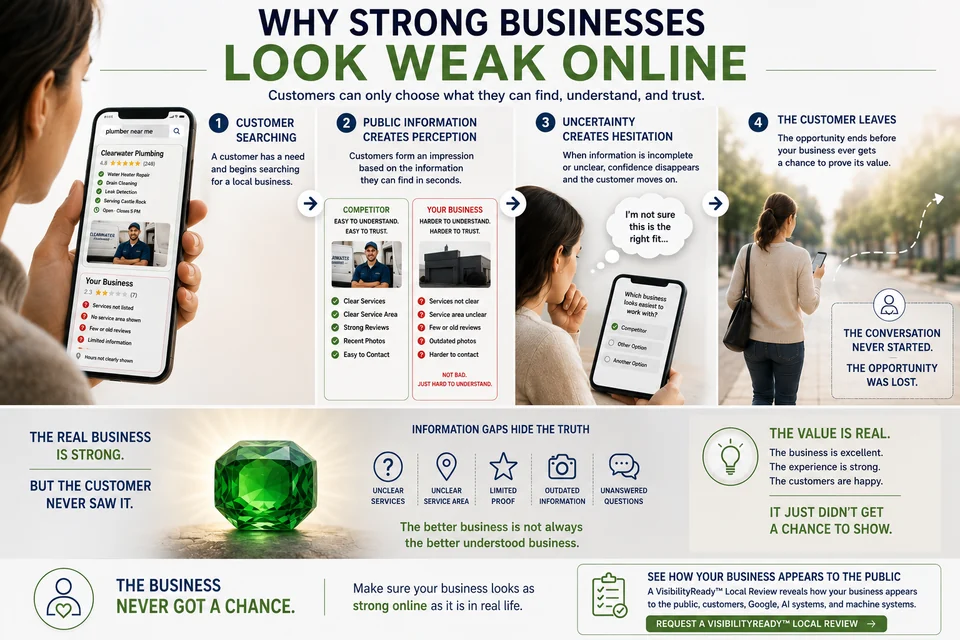
A business can be excellent in the real world and still appear average online when its public information no longer reflects the true value of the business.
Many business owners assume that if their company provides great service, customers will naturally recognize that value.
Customers can only evaluate what they can find, understand, and trust.
When business information becomes outdated, incomplete, inconsistent, or misaligned, customers may form an opinion that no longer reflects the reality of the business.
The business did not change. The understanding of the business changed.
The Real Business vs The Public Business
Customers Experience The Public Version First
Every business has two versions of itself.
The first is the real business. This is the business the owner experiences every day: the team, service quality, customer relationships, expertise, equipment, process, and results.
The second is the public business. This is the version customers encounter through the website, Google Business Profile, reviews, photos, service descriptions, local citations, and other public information.
Customers do not experience the real business first. They experience the public business first.
Why That Matters
A business may have decades of experience, strong reviews, and specialized expertise.
If that information is difficult to find, difficult to understand, or not communicated consistently, customers may never recognize those strengths.
The quality of the business and the quality of its public representation are not always the same thing.
Why Owners Often Miss The Problem
Owners Know The Business Too Well
Most business owners know their business so well that they unintentionally fill in missing information. Customers cannot.
The Owner May Think
We have been serving this area for years.
The Customer May Think
I am not sure they work in my area.
The Owner May Think
We specialize in this service.
The Customer May Think
I do not see that service clearly listed.
The Owner May Think
We have many happy customers.
The Customer May Think
I do not see enough proof to feel confident yet.
Information Misalignment
Small Information Misalignments Create Opportunity Erosion
Businesses rarely lose opportunity all at once.
More often, opportunity erodes gradually as small differences emerge between business reality and public representation.
A service is added but never fully reflected online. A service area expands but is not clearly communicated. Reviews accumulate but are not reinforced elsewhere. The website evolves while the Google Business Profile remains unchanged.
Each change may seem minor. Over time, these small information misalignments begin to affect how customers understand the business.
The Business Never Got A Chance
Information Drift Can End The Relationship Before It Begins
Many business owners assume customers evaluate the business and then decide against it.
In reality, many customers never reach the evaluation stage.
They encounter uncertainty. They become hesitant. They move on.
The opportunity ends before the relationship begins.
The Silent Part Of The Problem
Customers do not call to explain why they never called.
They do not submit a form to explain why they left.
They simply choose another option.
The business may have been the better choice. The customer never stayed long enough to discover it.
Before They Choose A Competitor
Why Is My Target Market Choosing My Competitors Over Me?
That question is often more useful than asking why the website is not ranking better or why the phone is not ringing more.
Most customers do not compare every available option. They compare the businesses they can understand most quickly.
If your services are unclear, they may choose the clearer competitor.
If your trust signals are difficult to find, they may choose the business that appears more trustworthy.
If your service area is not obvious, they may choose the company that appears more local.
Sometimes The Answer Is Understanding
The answer is not always price.
The answer is not always quality.
The answer is not always visibility.
Sometimes the answer is that one business is easier to understand, easier to trust, and easier to choose.
This Happens To Good Businesses
Growth Can Cause Public Information To Fall Behind
One of the biggest misconceptions about online visibility is that information problems only affect struggling businesses.
In reality, many of the businesses most affected by information drift are successful businesses.
Successful businesses evolve. Services change. Service areas expand. New specialties emerge. New staff members join. New proof develops. Customer priorities shift.
The business continues to grow and improve. The public information often struggles to keep up.
The Issue Is Usually Representation
This is not usually the result of neglect. It is often the result of growth.
The owner is focused on serving customers.
The website, Google Business Profile, service descriptions, photos, and supporting information gradually fall behind the reality of the business.
The issue is rarely the quality of the business. The issue is that the public-facing story no longer reflects the current business accurately.
The Current Business
Growth Creates A New Truth That Public Information Must Catch Up To
A business can improve faster than its website, profile information, service descriptions, and directory listings change.
When that happens, the old information may still be technically accurate in pieces while no longer representing the strongest or most important reality of the business.
The solution begins by making the current business easier to understand from the source it controls.
The Business Should Not Be Trapped By Its Old Description
When the business matures, its public representation should mature with it.
Why your website should reflect the business you operate today
Next Step
See How Your Business Appears To The Public
If customers, Google, artificial intelligence systems, and modern machine systems can only act on the information available to them, an important question naturally follows:
What business are they actually seeing?
Many business owners are surprised to discover that the public version of their business differs from the business they experience every day.
A VisibilityReady™ Local Review helps identify where those gaps exist across website clarity, Google Business Profile clarity, service visibility, local area visibility, trust signals, customer action paths, public story alignment, entity alignment, and machine readability.
The business did not change. The understanding of the business changed.