Business Clarity Article
How Your Business Gets Understood in Artificial Intelligence Answers
Your business should be clearly understood wherever customers encounter it.
That includes your website, Google Search and Maps, and answers generated by artificial intelligence. The practical question is the same: does the available information accurately explain the business you operate today?
The Plain-Language Meaning
What is answer engine optimization?
Answer engine optimization is the practice of making useful, accurate information easier for answer systems to find, interpret, and reference when responding to a question.
For a local service business, we approach that work through ordinary customer questions: What does this company do? Where does it work? What can it help with? What evidence supports its claims? How can someone take the next step?
A search result can introduce your business through a page title and description. An artificial intelligence answer may describe it directly and link to supporting sources. In either setting, the description needs to reflect the real business.
Google explains that its artificial intelligence search features build on existing search fundamentals. A page must be indexed and eligible for a search snippet to qualify as a supporting link; inclusion remains the platform’s decision. Read Google’s guidance on artificial intelligence search features.
Start With the Customer
A useful answer starts with a real question.
Consider a homeowner asking: “Can this garage door company repair my door, or does it only install new ones?” The website needs to make that distinction clear.
A broad description
“Quality garage door solutions. Great service. Call today.”
This leaves important questions open. Repair, replacement, availability, service area, and the next step still need explanation.
A more useful description
“We repair existing residential garage doors and install replacement doors in the communities listed on our service-area page. Contact us to describe the problem and confirm availability.”
This illustrates clearer information, rather than a claim about a particular contractor. Publish these details only when they are true.
Illustrative wording. The right explanation depends on the services, locations, availability, and policies of the actual business.
One Business. One Reality.
The public information should agree about the business.
Imagine a remodeler whose website emphasizes full renovations, whose profile still highlights handyman work, and whose contact page lists an old service area. An owner knows which description is current. A prospective customer has to sort through the conflict.
Our approach is to establish the current facts first, then align the important public information around them. The wording can vary by platform while the underlying business reality stays consistent.
Why your website and Google Business Profile should tell the same story
The VisibilityReady™ Approach
Build a clearer business source.
VisibilityReady™ considers these pieces together when reviewing an established local service business.
Current business facts
Explain the services, customer fit, service areas, contact methods, and boundaries that apply today.
Useful service explanations
Address the questions an owner hears before a customer books, compares options, or approves work.
Proof beside the claim
Connect relevant reviews, genuine project examples, photographs, experience, and verified credentials to the work they support.
Accessible information
Check whether important content can be reached, read, and followed through meaningful page links.
Consistent representations
Compare the website, Google Business Profile, and supporting business descriptions for material disagreements.
A usable customer experience
Review mobile loading, navigation, accessibility, and contact paths so a visitor can act on what they learn.
Google’s search starter guide supports useful, organized content, clear navigation, and descriptive links. Microsoft’s publisher guidance also emphasizes clarity, evidence, accuracy, and consistency across content formats.
What Recognition Can Look Like
Our example shows the business being identified.
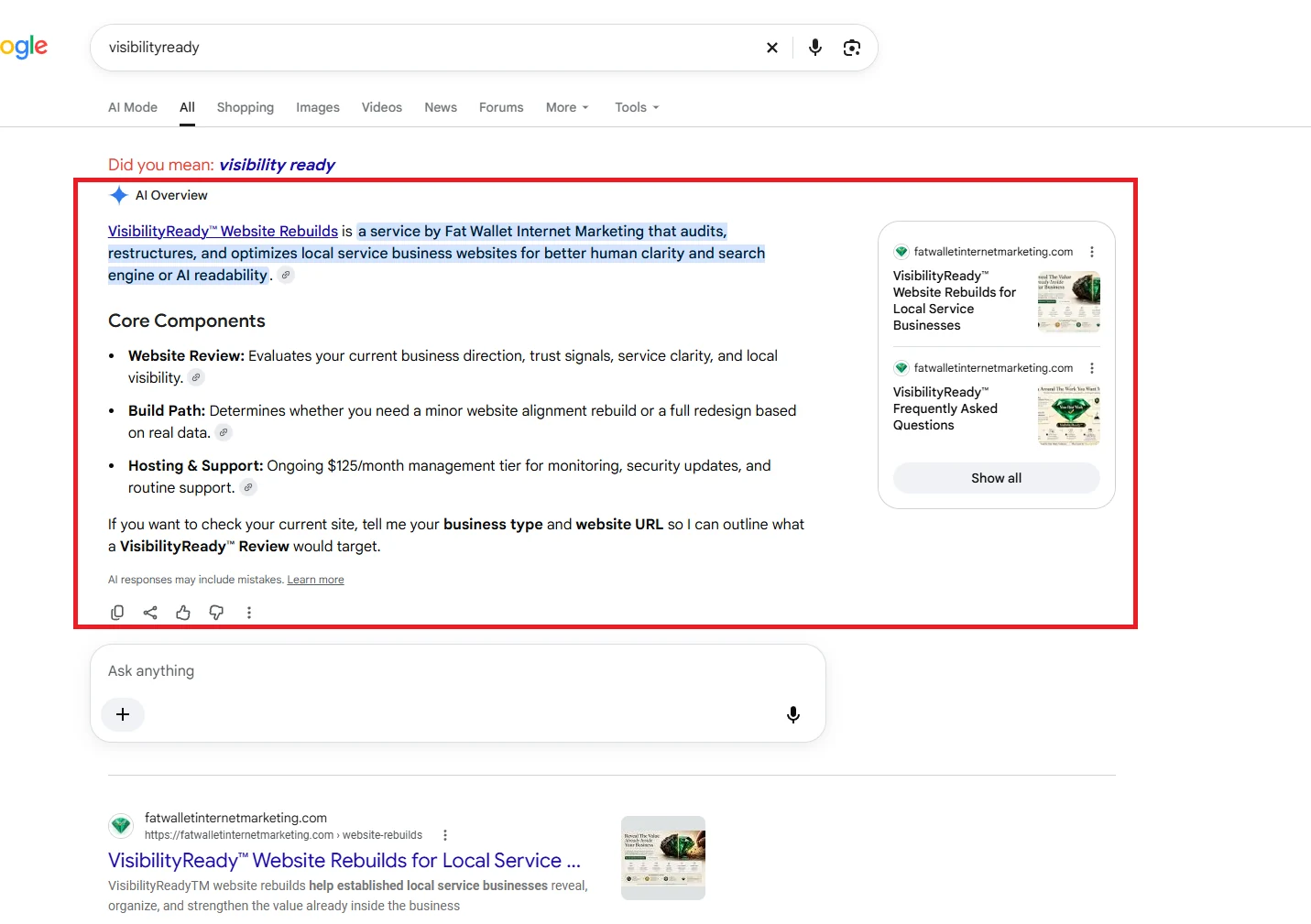
The screenshot above records a Google search for “visibilityready.” The generated overview connects VisibilityReady™ with Fat Wallet Internet Marketing, describes its services, and cites pages from this website.
That is a useful example of branded recognition. Someone searching a business name is asking a different question from someone searching for a provider they have never heard of.
The screenshot cannot tell us which individual website change produced the result or how many inquiries followed. It gives us a dated observation to compare with later evidence.
Measure the next steps separately.
Record whether the business is described accurately, whether relevant pages are cited, whether people visit, and whether those visits become qualified inquiries. Each answers a different business question.
Where available, Bing’s artificial intelligence performance reporting can show citation activity across supported experiences. Citation counts describe references to content; they do not establish sales or placement within an individual answer. See Microsoft’s reporting explanation.
Questions Business Owners Ask
Understanding the approach and recognizing progress.
Explore these questions about answer engine optimization and search engine optimization.
How do I know if AEO is working?
Look for a pattern across accurate descriptions, relevant citations, website visits, and qualified inquiries. Each tells you something different.
Keep dated examples of the questions asked and the answers shown. Separate searches for your business name from searches by people who do not already know you. Check whether the answer correctly describes your services, service area, and customer fit.
Where available, use platform reporting to track cited pages and citation trends. Ask new prospects how they found you, and record meaningful inquiries separately from mentions or visits. Compare similar reporting periods; one screenshot is a useful observation, while repeated evidence gives you a stronger basis for decisions.
What is the difference between AEO and SEO?
The difference is the immediate visibility goal. Search engine optimization helps people discover and evaluate your website through search results. Answer engine optimization focuses on making your information useful when a system responds to a question, explains a service, or references a business.
The two overlap. Google states that its existing search fundamentals also apply to its artificial intelligence features. Clear, useful, accessible content can support both approaches. Read Google’s guidance.
How is AEO different from SEO?
In the day-to-day work, the emphasis shifts toward how well your content answers the customer’s question. Alongside reviewing search visibility, we examine whether a service page explains who the service is for, when it applies, what proof supports it, and how to take the next step.
For example, a furnace repair page might clearly distinguish a repair visit from a replacement consultation. That explanation helps a customer decide and gives an answer system more specific information to work with.
Much of the foundation is shared. The practical addition is to assess the accuracy of generated descriptions and references alongside website discovery, usability, and inquiries.
Is AEO only for big brands?
No. These principles are relevant to local service businesses too. A smaller business may have valuable knowledge about its specialty, service process, local coverage, and the questions its customers ask.
Build around the work you actually perform and the evidence you can provide. A specialist contractor can explain a particular service in useful detail without trying to cover every topic in its industry.
Business size alone does not establish whether a page will be referenced. The opportunity is to make your actual expertise and customer fit easier to understand.
What kind of content works best for AEO?
Prioritize content that answers a real customer question clearly and supports the answer with relevant evidence. For an established service business, useful starting points include:
- Service pages explaining the problem, scope, customer fit, and next step.
- Comparisons that help a customer choose between appropriate options.
- Genuine project examples describing the situation, work, and outcome.
- Frequently asked questions drawn from actual customer conversations.
- Current service-area, process, and contact information.
Keep each page focused. Use descriptive headings, direct explanations, and proof that belongs to the claim. The strongest topic is often a question you already answer regularly for customers.
What is brand visibility in AEO?
Brand visibility is how your business appears and is represented in answers generated by artificial intelligence. An answer might mention your name, describe your services, or cite a page from your website. Those are different forms of visibility.
Our screenshot above shows branded recognition: someone searched for VisibilityReady™, and Google identified the business behind it. A separate question is whether the business appears when someone asks about a service without naming a provider.
Track both the presence and the accuracy of those appearances. The business value comes from reaching relevant people with a description that helps them understand whether you are a suitable choice.
The Practical Next Step
Find out what your public information makes clear—and what it leaves uncertain.
A VisibilityReady™ Review examines how the current website and public business information represent an established local service business. It helps determine what to preserve, what to clarify, and whether targeted improvements or a rebuild make sense.
The work supports accurate understanding across customers, search, and artificial intelligence systems. External platforms control their own results, citations, and recommendations.
Sources and further reading
Official guidance checked October 19, 2026. The VisibilityReady™ examples and review approach are our practical application of business clarity principles.